
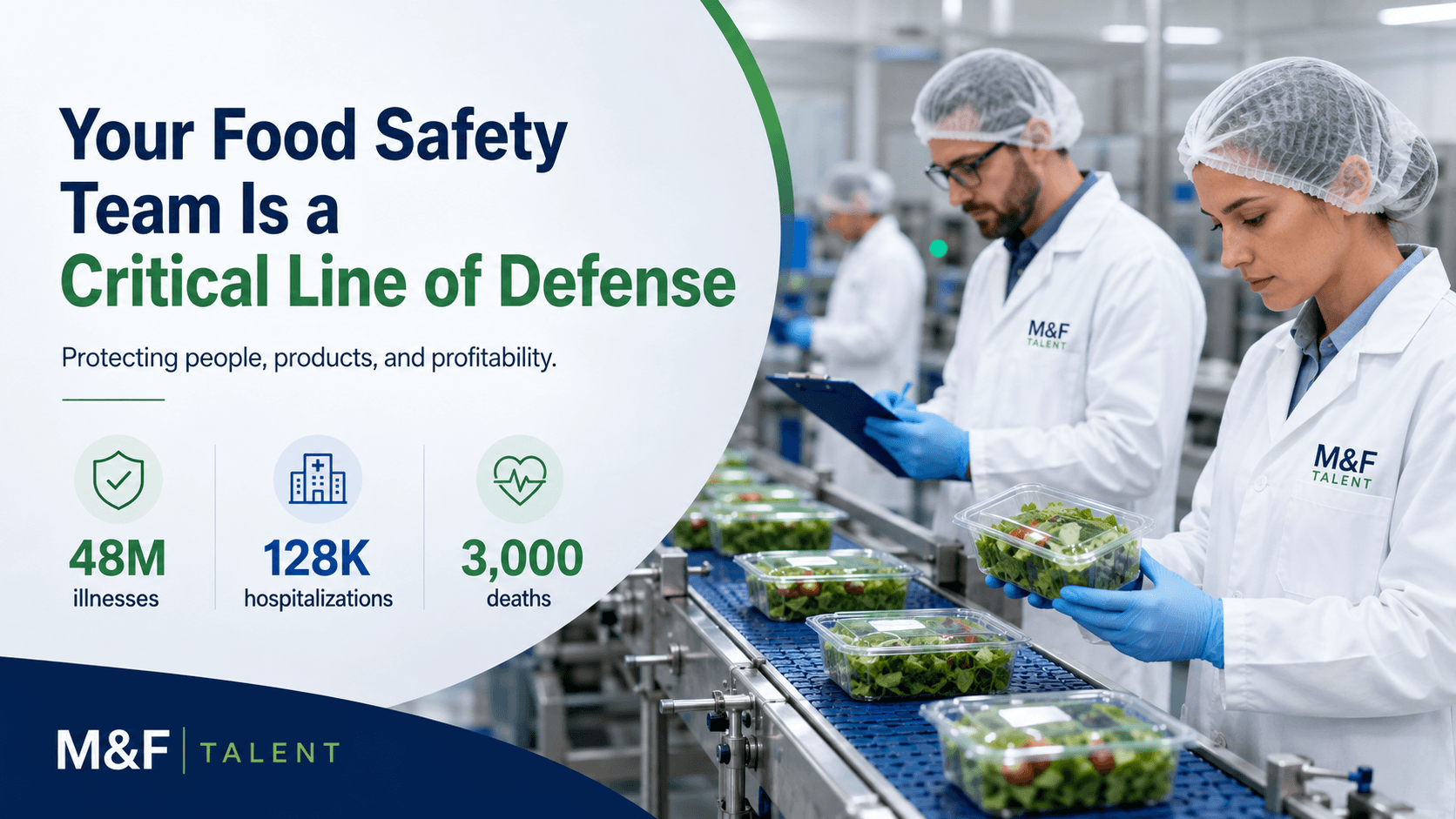
Your Food Safety Team Is a Critical Line of Defense
The FDA estimates that foodborne illnesses affect approximately 48 million Americans each year, resulting in 128,000 hospitalizations and 3,000 deaths.
Food manufacturers can invest millions in processing equipment, sanitation systems, testing, traceability, and regulatory compliance. Yet, no matter how sophisticated the facility, those safeguards still depend on people who run them.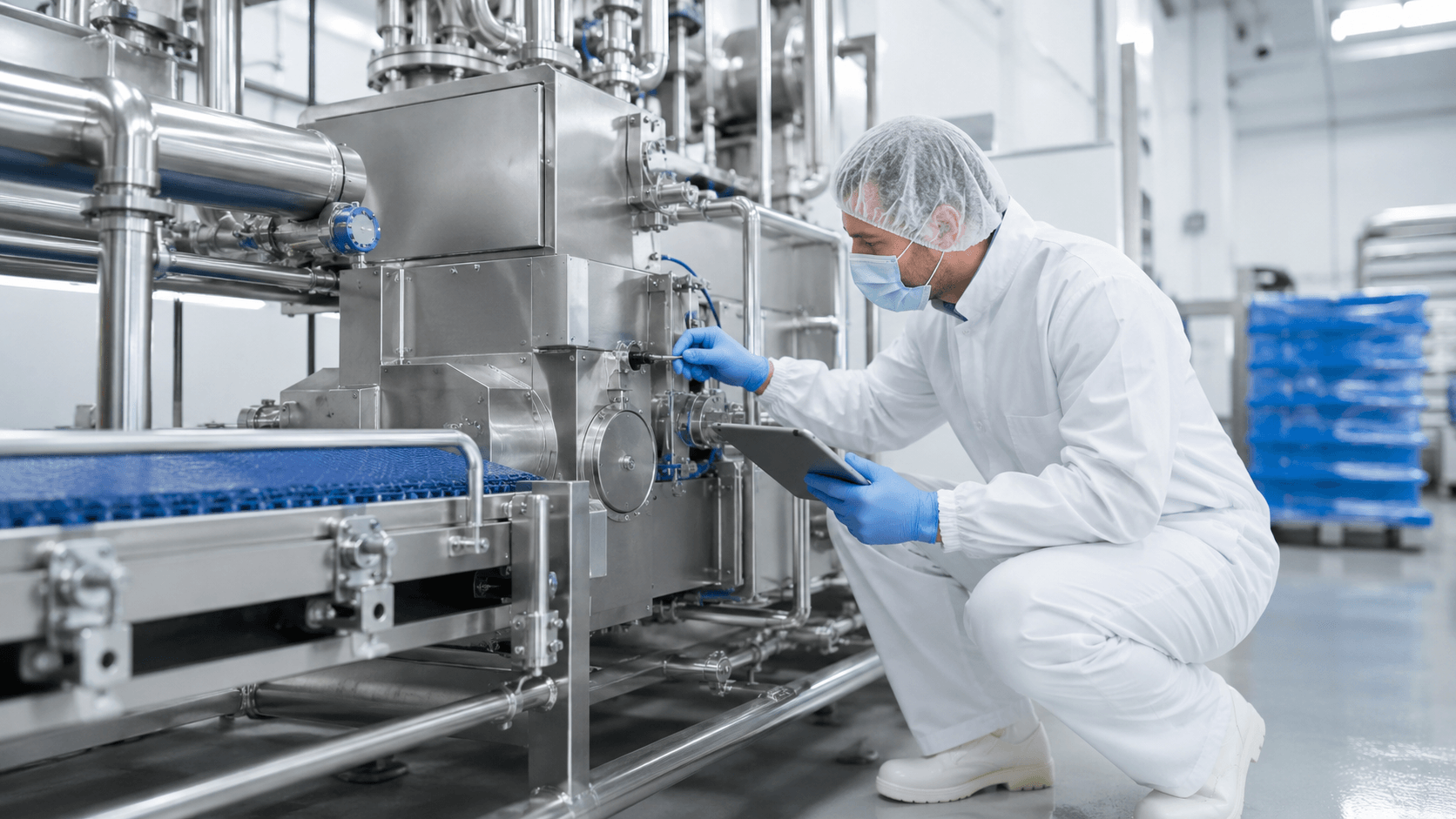
For manufacturers, a food-safety failure can trigger consequences that extend far beyond a single production run: product holds, recalls, regulatory scrutiny, lost customers, lawsuits, and long-term damage to the brand. That makes your quality assurance and quality control professionals some of the most important people in the plant.
In this article, M&F Talent explores key food safety team jobs and their importance in compliance – as well as profitability.
Quality Control Extends Far Beyond Testing Finished Products
An experienced food safety team can recognize risks before contaminated or nonconforming products leave the facility, determine what went wrong when a deviation occurs, and build systems that reduce the chances of the same problem happening again.
To illustrate the point, consider the 2026 Cyclospora outbreak associated with processed iceberg lettuce from Taylor Farms de Mexico. With this incident, the CDC reported:
- 10,930 illnesses across 17 states
- 454 hospitalizations
- 2 deaths
Moreover, recalled products had been confirmed to be distributed in more than 30 states, with possible distribution extending even further. Unfortunately, that’s the scale a food-safety problem can reach once an affected product enters a large supply chain. It also demonstrates why modern quality control can’t begin at the end of the production line.
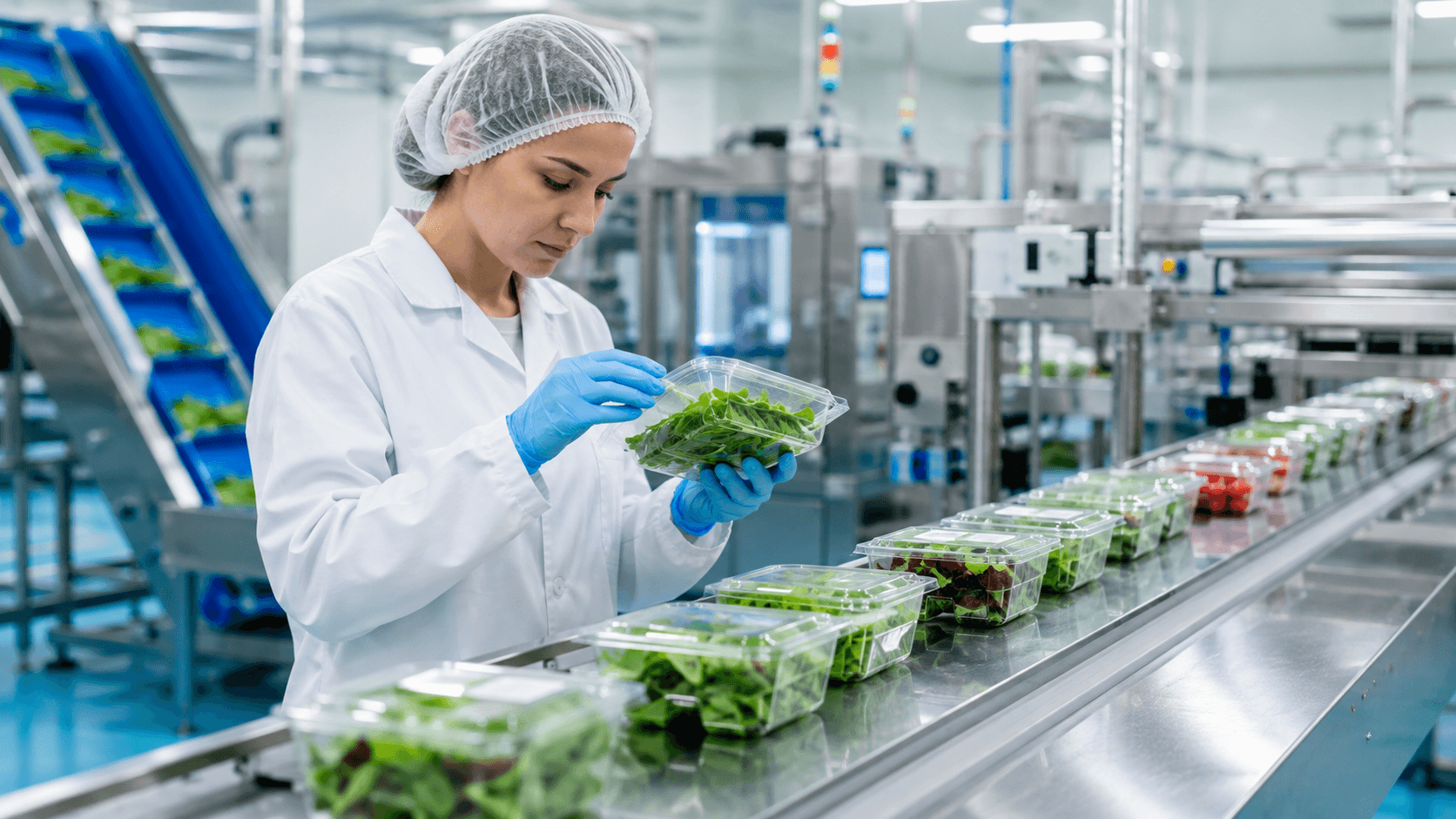 The Food Safety Modernization Act (FSMA) shifted federal food-safety policy toward prevention. Under the FDA’s Preventive Controls for Human Food rule, covered facilities must identify known or reasonably foreseeable hazards and establish preventive controls when necessary to significantly minimize or prevent those hazards. That means overseeing a complex web of:
- Hazard analyses
- Allergen controls
- Sanitation oversight
- Process controls
- Supplier verification
- Corrective actions
- Recall planning
As a result, food safety teams often work across nearly every function in a food manufacturing facility. They may coordinate with production when a process falls outside specification, sanitation when environmental testing identifies a concern, procurement when an ingredient creates a supplier risk, maintenance when equipment conditions could compromise food safety, or senior leadership during an audit or recall.
4 Critical Quality Control Jobs in Food Production

1. Quality Control Technician
Quality Control Technicians are among the people closest to day-to-day production, which puts them in an important position to identify problems early. Depending on the facility, technicians may collect product and ingredient samples, perform standardized tests, check temperatures, weights, pH, moisture, packaging, and labels, document results, and identify products that fall outside specifications.
That work demands consistency and attention to detail. A temperature that’s slightly outside an acceptable range or a mislabeled allergen can look like a small deviation on the production floor – while still carrying much larger consequences downstream.
- The Bureau of Labor Statistics reports that food science technicians test food and related materials for compliance with safety standards and analyze their findings to support quality control. Median pay for food science technicians was $49,090, and employment in the broader agricultural and food science technician category is projected to grow 5% from 2025 to 2035.
2. Food Safety / QA Manager
If QC technicians are watching the production floor, the Food Safety or QA Manager is responsible for making sure the entire system holds together.
They oversee food safety plans, HACCP and preventive controls, sanitation and allergen programs, corrective actions, audits, testing, and employee training. In practice, this can mean stopping a production line, holding a batch, investigating a deviation, or defending a decision during an audit. These roles require the technical expertise and confidence to make difficult calls when food safety conflicts with production schedules.
- As of August 2026, ZipRecruiter estimated average U.S. compensation for Food Safety Quality Assurance Managers at approximately $86,000 per year, although salaries vary significantly based on experience, location, facility size, and
- responsibilities.

3. Supplier Quality Manager
Food-safety risk starts well before ingredients reach your production line. Manufacturers can inherit problems from ingredient suppliers, packaging vendors, contract manufacturers, and other partners across the supply chain.
Supplier Quality Managers help control risk by overseeing supplier qualification, audits, specifications, certificates of analysis, corrective actions, testing, and ongoing supplier performance. Under FDA preventive-control rules, certain manufacturers must also maintain risk-based supply-chain programs when suppliers control food-safety hazards.
All things considered, these are highly technical roles. Strong candidates need to understand manufacturing, regulatory requirements, and risk assessment, while working directly with vendors to correct problems before they reach the plant.
- As of August 2026, ZipRecruiter estimated average Supplier Quality Manager pay at approximately $107,000 per year.
4. Food Manufacturing Maintenance Engineer
Maintenance might not be the first department you associate with food safety, but equipment problems can quickly become food-safety problems. Worn seals can harbor residue, damaged surfaces can be difficult to sanitize, and refrigeration failures can create temperature-control issues.
Maintenance Engineers help prevent problems by maintaining equipment, troubleshooting failures, evaluating sanitary design, and coordinating repairs with production, sanitation, and QA teams. FDA Current Good Manufacturing Practices also require equipment to be adequately maintained to protect against contamination.
In food production, Maintenance Engineers bring together mechanical expertise and food-safety knowledge to keep equipment reliable, cleanable, and suitable for sanitary production.
- Indeed estimates average Maintenance Engineer pay within its Food Manufacturing employer dataset at roughly $111,000 annually, although reported salaries vary considerably by employer and location.
The Hidden Costs of a Weak Food Safety Team
Food-safety failures can become expensive well before they develop into a full-scale recall. A production line may stop while a problem is investigated, ingredients or finished products may have to be held or discarded, and shipments can be delayed while teams determine how far the issue extends. If affected products have already entered the supply chain, manufacturers face further issues like customer chargebacks, regulatory scrutiny, legal costs, lost contracts, and damage to consumer trust.
- An FDA analysis citing Grocery Manufacturers Association research found that food companies that experienced a recall estimated its financial impact at up to $30 million, while 23% reported costs exceeding $30 million.
Build Stronger Food Safety Teams with M&F Talent
Strong food safety professionals need more than technical credentials. They need the judgment to apply that expertise on the plant floor, lead through audits and corrective actions, and make difficult calls when production pressures compete with food-safety priorities.
M&F Talent recruits experienced professionals across food safety, quality, maintenance, and operations who understand both the requirements and the realities of food manufacturing. Contact us to find professionals who can help protect your products, customers, and operation!


Leave A Comment