
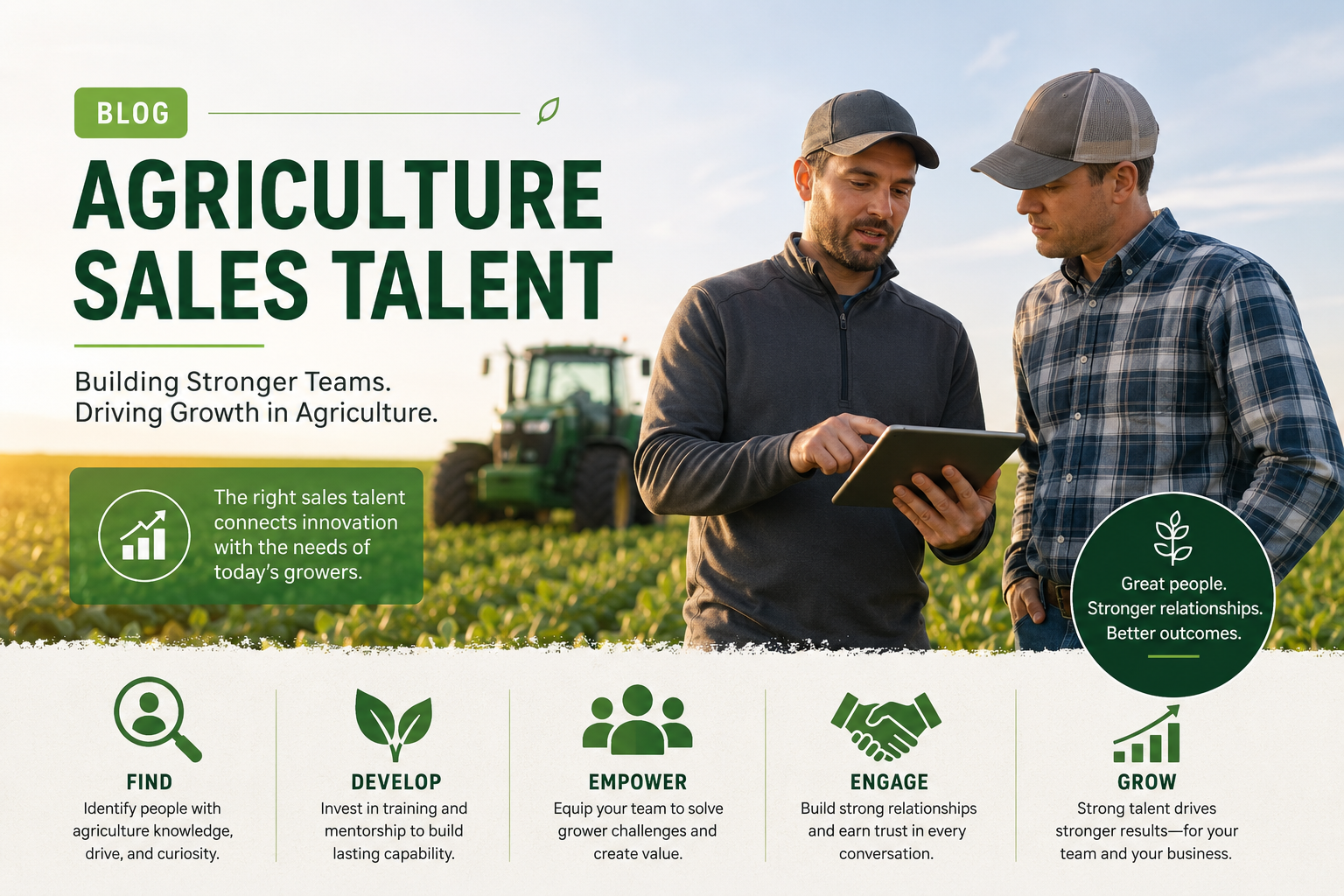
Market Evolutions for Agriculture Sales Talent in 2026 & Beyond
If you’re hiring agricultural sales talent today, you’re hiring into a very different job market than you would have been just five years ago. In 2026, farmers, growers, distributors, retailers, and agribusiness leaders are making purchasing decisions under intense pressure. Margins remain tight, and costs remain volatile.
New technologies might promise added efficiency, but with a significant upfront investment. And geopolitical uncertainty around commodity markets, trade, and financing continues to shape decision-making across agriculture. Fertilizer markets, for one, are exceptionally sensitive to global trade shifts, energy prices, export restrictions, and geopolitical disruption.
To account for these market challenges, an agricultural salesperson who could once rely primarily on relationships and product familiarity is now expected to wear many more hats. Today’s agricultural buyers want someone who understands their operation, speaks their language, and can clearly explain how a product will reduce risk and strengthen profitability.
That’s why the new standard for agriculture sales talent is built around three capabilities:
1) Technical fluency
2) ROI-driven communication
3) Buyer trust
Agriculture Buyers Are Under More Pressure Than Ever
Every purchase decision in agriculture now carries far more scrutiny than it once did. Whether you’re selling crop inputs, greenhouse systems, precision agriculture tools, or equipment, buyers are evaluating every investment through the lens of operational risk and financial return.
- A quick look at the numbers explains why: USDA forecasts show that inflation-adjusted net farm income is expected to decline by 2.6% from 2025 to 2026. At the same time, farmers continue to face the aforementioned pressures from labor shortages, financing costs, input volatility, and supply chain disruptions.
- Input affordability is a top concern for farm operators: the American Farm Bureau reports that 70% of surveyed farmers say they can’t afford the fertilizer they need. This highlights just how sensitive many operations remain to rising costs and market uncertainty.
In this kind of environment, buyers aren’t simply looking for the newest product or technology. They’re looking for confidence. If you’re selling an automation platform to a greenhouse operator, for example, the conversation rarely starts and ends with product features. A buyer wants to know whether the system will reduce labor dependence, improve consistency, integrate with existing equipment, and simplify management. They want to know if it will pay for itself.
No longer is the question, “What does this product do?” Now, buyers want to know why this investment makes sense right now.
1. Technical Fluency is Now a Core Sales Skill
Every salesperson doesn’t need to be an agronomist, engineer, crop consultant, or software developer all in one. However, technical fluency has become an important differentiator among top-performing agriculture sales professionals. You need enough technical understanding to connect product capabilities with real-world operational outcomes. As agricultural products become increasingly sophisticated, that need is underscored.
- Precision agriculture tech: these systems generate vast amounts of data, with tools like yield monitors, yield maps, and soil maps used on approximately 68% of large-scale crop-producing farms.
- Biological products: require nuanced conversations about performance and application timing to be used correctly and profitably.
Your buyers are dealing with such complexities every day. So, when they ask questions about implementation, compatibility, performance expectations, and maintenance requirements, they expect informed answers, not something canned out of a sales manual.
The strongest agriculture sales talent will act as a translator, taking complex product information and converting it into practical insights to help buyers make informed decisions. They explain how a product works and why it matters.
2. Buyers Want ROI, Not Product Features
Buyers still care about product features. But first, they need to understand logical business use cases. When you’re selling into agriculture, every conversation eventually comes back to ROI, and to your ability to answer these core questions:
- Can this technology save labor?
- Will it improve yield?
- Can it reduce downtime?
- Will it improve crop quality?
- Can it increase efficiency or reduce input costs?
- Will it provide better visibility into operations?
- Can it help solve a specific operational bottleneck?
Producers remain focused on future profitability, yield improvement, and technology adoption, but also have concerns about barriers to implementation. They’re interested in innovation, but they need convincing evidence that what you’re selling will be the investment needed to deliver meaningful results.
Strong agriculture sales talent separates itself from average sales talent in this dimension in particular. A technically fluent salesperson can easily connect product performance directly to financial outcomes. For example, if you’re selling a biological product, focusing solely on sustainability messaging may not be enough. Buyers may be more interested in understanding how the product fits within their broader crop management strategy.
The most effective salespeople can explain what a product does, but more importantly, why that outcome matters.
3. Trust Depends on Credibility
While buyer relationships remain critical, trust today is built differently than it was in the past.
Modern agriculture buyers have access to more information than ever before. They can research products online, compare options, watch demonstrations, and gather feedback from peers long before they speak with a sales representative. By the time they engage with your team, they’re often looking for validation rather than a sales pitch.
As such, credibility has become one of the most important traits for agriculture sales talent. Importantly, credibility only comes from thoroughly understanding a buyer’s operation. You gain this understanding by asking thoughtful questions and acknowledging limitations when they exist. It comes from providing practical guidance instead of exaggerated promises.
So the most trusted salespeople don’t avoid difficult conversations. They embrace them. They can explain where a solution works exceptionally well, where challenges may exist, and what support will be available after implementation. This reduces uncertainty, builds confidence, and opens the door to additional follow-through.
The Role of Specialized Agriculture Recruiting
The cliché “finding a needle in a haystack” doesn’t apply anywhere quite as well as it does to the current challenge of filling agricultural sales roles. Many organizations discover that traditional recruiting approaches struggle to identify candidates with the right combination of technical knowledge, commercial experience, and industry credibility. This is often because successful agricultural sales professionals possess a highly specialized blend of skills.
Finding the intersection of both skill sets requires a deeper understanding of the agriculture industry itself. Specialized agriculture recruiters understand the nuances of:
- Different product categories
- Buyer personas
- Market segments
- Economic changes
They know which backgrounds translate successfully into specific sales roles and which candidates are likely to gain credibility quickly with customers. The best agribusiness recruiters also know where to find passive candidates: professionals who are successful in similar markets but aren’t actively searching for new opportunities.
Mac & Fulton: Find Agriculture Sales Talent Built for Today’s Market
Recent Purdue University and CME Group Ag Economy Barometer data shows farmer sentiment continuing to soften, with high input costs remaining one of the industry’s top concerns. Sales professionals need to understand the economic pressures their customers face and communicate value in clear, ROI-driven terms. They also need to be confident dealing with new technological advancements and biological products.
At M&F Talent, we help agriculture companies find sales professionals who can:
1) Explain ROI
2) Handle technical discussions
3) Earn trust through credibility
Contact us today to start building a winning agriculture sales team!


Leave A Comment